

How Buy-Feature Bonuses Work in Slots: The Maths and the Risks of “Buying the Bonus”
Bonus buy (often called “buy-feature”) is a slot option that lets you pay a fixed multiple of your stake to trigger a bonus round immediately. It sounds simple: skip the wait, jump to free spins or a special feature, and hope for a bigger hit. The reality is more technical. You are swapping many small spins for one highly volatile event, and the house edge is still there—just concentrated into fewer, much sharper outcomes.
What a bonus buy really is (and what changes when you use it)
In most modern video slots, the bonus round is a rare event funded by the money lost during base-game spins over time. When you buy the feature, you are paying up front for the right to “enter the variance” instantly. The most common pricing model is a multiplier of your current bet—often 50x, 75x, 100x, 150x or 200x—though some games also offer several tiers (for example, a cheaper version with fewer modifiers, and a pricier version with enhanced symbols or guaranteed extras).
The key point is that the cost is not a “deposit” towards a bonus; it is a separate wager with its own expected value (EV) and distribution of results. If the feature-buy RTP is 96% and the price is 100x stake, the long-run EV of that purchase is 96x stake. The missing 4x stake is the house edge for that single decision, concentrated into one highly variable outcome. Over a small number of buys, anything can happen—including long losing streaks that feel unfair but are completely within normal probability.
Bonus buys also change the pacing of risk. A standard session might be 500–2,000 base spins with many small wins that soften the swings. A bonus-buy session might be 10–50 purchases, where each result can be anywhere from 0x to several hundred x (or more) depending on the game’s design and max-win cap. That compression makes your bankroll sensitivity much higher: one or two poor outcomes can wipe out what would otherwise be a long session.
Why the same RTP can still feel “worse” with bonus buys
RTP is a long-run average, not a promise for a session. Two bets can share the same RTP and still feel completely different because the volatility (variance) is different. Bonus buys almost always increase variance: you are paying a big fixed price to access a feature with a wide payout range. That means the probability of landing below cost is usually high, even if the average eventually balances out over a huge sample.
A practical way to picture it is the break-even line. On a 100x buy, you only “profit” if the feature returns more than 100x stake. Many bonus rounds will return below that—sometimes far below—because the design includes frequent low or medium outcomes and rare high hits that drag the average upwards. So even with a fair-looking RTP, a player can experience many consecutive “loss buys” before seeing a single standout result.
There is also a common misunderstanding around “the bonus pays better than base spins.” A bonus round can have higher average win per event than a random base spin, but you are paying a very large entry fee for it. What matters is not whether free spins can produce big numbers; it is whether the distribution of outcomes, after paying the entry price, delivers acceptable risk for your bankroll and limits. In many games, the risk profile is harsh by design because the high end is supported by long runs of under-cost outcomes.
The maths you can use: EV, house edge, variance, and bankroll impact
You do not need advanced statistics to evaluate a bonus buy. Start with EV. EV = (price) × (RTP). If the price is 100x and the feature-buy RTP is 96%, EV is 96x. In plain terms, if you could repeat the identical buy an enormous number of times, you would average a loss of 4x per purchase. That does not mean you will lose on every buy; it means the average outcome is below the entry cost by that margin.
Next, focus on variance. Variance is what makes two people have completely different stories about the same game. Bonus buys tend to have a heavy-tailed distribution: many small-to-mid returns, and a small chance of a large return. The heavier that tail, the more your results depend on whether you “hit the rare one” within your sample. This is also why comparing “I did 20 buys and it paid” with “I did 20 buys and it crushed me” tells you almost nothing about the true quality of the bet.
Finally, apply bankroll logic. A useful rule of thumb is to treat one bonus buy like a mini-session. If a 100x buy costs £/€10 (because your stake is 0.10 and the multiplier is 100), doing 20 buys is already £/€200 of exposure, but concentrated into just 20 outcomes. If your usual base-spin session budget is £/€50–£/€100, a handful of buys can exceed that risk very quickly. This is why bonus buys often cause overspending: the “one click” entry hides the scale of the wager.
A worked example with realistic numbers (and why small samples mislead)
Imagine a slot where the buy price is 100x stake and the published feature RTP is 96%. If your stake is £0.20, one buy costs £20. The long-run EV is £19.20. The house edge per buy is £0.80. That is straightforward, but it does not tell you what will happen over your next 10 buys.
Now consider a simplified payout pattern (not a real game table, just a realistic shape): many outcomes around 10x–60x, a decent chunk around 60x–120x, and rare outcomes above 200x that keep the average afloat. In such a shape, it is completely normal to see 6–9 buys out of 10 return below the £20 cost, with the session result determined by whether you catch one or two above-cost outcomes. You can be “up” with one 250x hit, or “down” heavily with none—despite the same underlying RTP.
This is why chasing short-term balance is dangerous with bonus buys. If you increase stakes after a run of low returns, you are not “due” a better bonus. Each buy is independent. The maths does not remember your last outcome, and many games are designed so that the big wins are rare enough that trying to force them within a budget often ends badly.
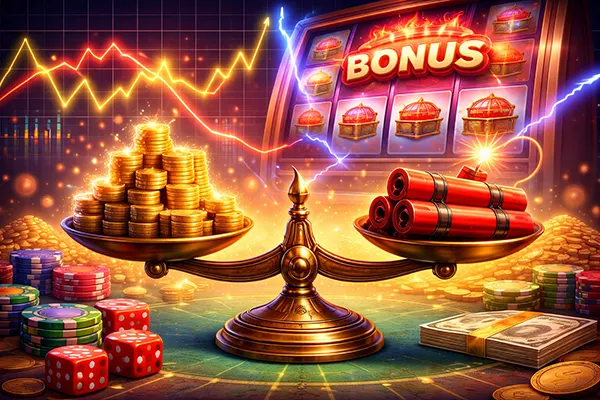
Risks that are specific to bonus buys (beyond “you can lose money”)
The first risk is behavioural: bonus buys feel like you are controlling the game, but you are mostly controlling only the timing of variance. That illusion of control can increase spending because the feedback loop is fast—pay, feature, result—without the slower pace of base spins. Players often do “just one more buy” far more easily than “just 500 more spins,” even when the money at risk is similar or higher.
The second risk is structural: many slots have a maximum win cap (for example, 5,000x–20,000x stake). On some titles, the cap can effectively limit the upside of a very expensive buy. If you are paying 200x to enter a feature but the game’s cap is modest, the risk-reward profile may be worse than it looks at first glance. A cap does not change RTP by itself, but it can change how “top heavy” the distribution can be, which matters if the buy price is high.
The third risk is availability and rules. Bonus buys are not universally offered in every jurisdiction, and in some regulated markets operators may disable them or offer modified versions. Even within the same game title, studios can ship different configurations (including RTP variants) depending on the operator’s settings and local rules. As a player, you should treat “I saw this on a stream” as non-evidence: always check the specific game info panel where you are playing, because the numbers and options can differ.
Practical checks before you pay for a feature
First, find the RTP information that applies to the feature buy, not only the base game. Some games show a single RTP for standard play; others show an additional figure or mention that the buy option may use a different RTP setting. If you cannot find any relevant information in the game help or info screen, assume you are operating with incomplete data and lower your stakes accordingly.
Second, translate the buy price into your real currency and compare it to your budget. “100x” is abstract; £20, €50, or 300 DKK is not. Decide in advance how many buys you are prepared to do, and treat that number as a hard cap. Bonus buys can drain a bankroll quickly precisely because the entry cost is large and the outcomes cluster below break-even in many designs.
Third, use risk controls that match the volatility. If you normally set a deposit limit, loss limit, or session timer, keep them on. Bonus buys are the sort of feature that can turn “I’ll play for 15 minutes” into “I’ve done 30 buys” without noticing. The maths does not punish you for being impulsive; your bankroll does. If you want the entertainment of the feature, consider lowering stake size rather than reducing the number of buys, because it keeps exposure under control while still letting you experience the mechanic.
Popular articles
-
 How to Find Your Own Casino...
Finding a personal playing style in a casino is not …
-
 Casino Verification Without...
Identity verification has become one of the most discussed aspects …
-
 Autoplay Features and Fast ...
Automatic spins and accelerated game modes have become standard features …